Key Highlights
- Kuwait is India's 29th largest agricultural export destination.
- India exported 1.14 million MT of agricultural products worth USD 499.14 million to Kuwait.
- Basmati rice is India's largest agricultural export to Kuwait by value.
- Marine products, coffee, buffalo meat, and spices are among the leading export categories.
- Kuwait's reliance on food imports creates consistent opportunities for Indian exporters.
- Product quality, Halal compliance, and food safety standards remain critical for market access.
Introduction:
The bilateral trade landscape between India and the Gulf Cooperation Council (GCC) remains highly active, built on long-standing commercial partnerships and mutual economic interests. Within this Gulf trade network, Kuwait is an important destination for Indian agricultural exports within the GCC. Exporters operate within an ecosystem where India has maintained a steady agricultural export relationship with Kuwait.

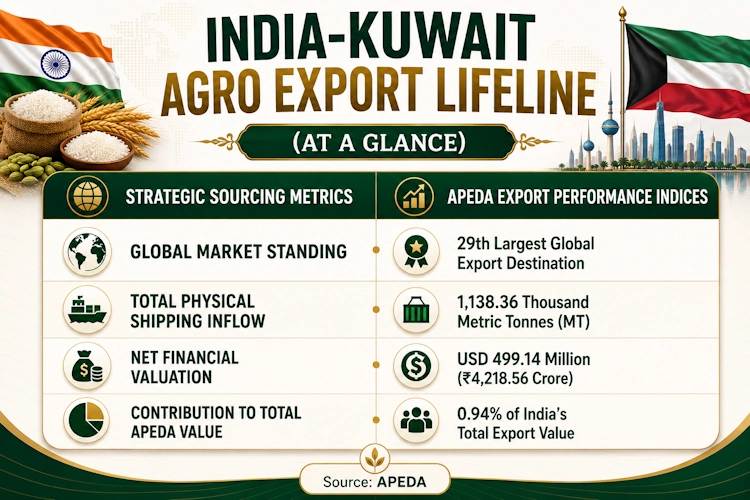
According to official statistics published in the APEDA Analytical Report on India's Export of All Agri Products, Indian food exports to Kuwait have established a valuable and highly consistent footprint in the region. Exporters looking to export food to Kuwait operate within a regular trade flow.
During the fiscal year, India successfully shipped a total export quantity of 1,138.36 thousand metric tonnes (MT) of agricultural products to Kuwait. This massive flow of commodities generated a net export value of USD 499.14 million—equivalent to ₹4,218.56 crore.
This performance makes Kuwait one of India's important agricultural export destinations in the Gulf region, accounting for a strategic 0.94% of India's total global agricultural export value and positioning the nation as India's 29th largest destination for agricultural exports.
For processing operations, large-scale mills, and international trading desks looking to scale their cross-border sales, Kuwait continues to generate consistent demand for several Indian agricultural products. Rather than relying on a single commodity stream, the import demand across Kuwait spans several high-value food categories.
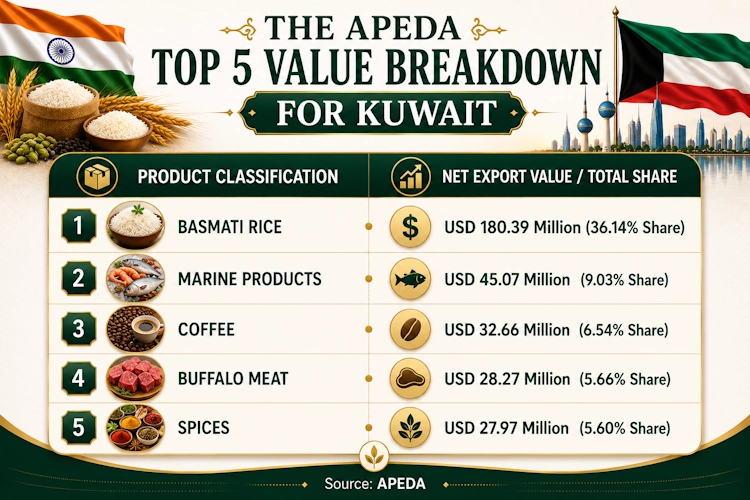
The top five agricultural exports—Basmati Rice, Marine Products, Coffee, Buffalo Meat, and Spices—together contributed nearly 63% of India's total agricultural exports to Kuwait.
To expand business footprints, global suppliers are increasingly moving past small spot-market sales to enter the Kuwaiti wholesale market and distribution network, shifting their focus toward products that clear strict import quality and food safety standards.
The Core Sourcing Channels: Top Indian Agro Products Exported to Kuwait
Analyzing the definitive performance charts of the leading product categories allows agri-enterprises to easily align their processing capacities with active global buying corridors.

1. Basmati Rice: The Premium Heavyweight Champion
Basmati Rice stands out as India's single largest agricultural export to Kuwait by a significant margin. Valued at an export value of USD 180.39 million, this single grain classification contributed an absolute 36.14% of India's total agricultural exports to the country during the fiscal cycle. Rice functions as a non-negotiable dietary foundation across Kuwaiti retail networks, driving steady, year-round procurement requests for premium long grains.
For processing enterprises aiming to build long-term value, the strategy to export basmati rice to Kuwait distribution houses represents a highly stable commercial avenue. Kuwait imports significant volumes of premium Indian basmati rice for retail and food-service sectors.
Within this space, executing a dedicated trading strategy remains a highly active business lane. Popular export varieties include 1121 Steam and Golden Sella rice, which are regularly sourced to satisfy strict quality specifications enforced across the region's food processing and hospitality networks.
2. Marine Products: The Seafood Pipeline
Marine products constitute Kuwait's second-largest agricultural import category from India, highlighting the continuous consumer demand for Indian seafood. Generating an export value of USD 45.07 million, this segment accounted for a valuable 9.03% of India's agricultural exports to the country.
To maintain stable cold-storage inventory levels across the country's extensive retail and food-service grids, Kuwaiti buyers absorb large-scale container lots of high-quality seafood items. For commercial processing facilities, this consistent demand provides a steady pipeline, provided all shipments maintain flawless cold-chain temperature logs from the origin plant to the final delivery dock.
3. Coffee: Fueling the Regional Beverage Market
Reflecting a mature consumer base that demands premium lifestyle options and affordable staples, Coffee ranked as the third-largest agricultural export category to Kuwait. Shipments generated an export value of USD 32.66 million, capturing a stable 6.54% share of the import layout.
This category satisfies the extensive volume requirements of commercial food service blenders, local packaging houses, and the expanding cafe culture across Kuwait, allowing suppliers to maintain high asset utilization across their roasting and processing operations and export coffee in bulk to Kuwait.
4. Buffalo Meat: Anchoring the Protein Supply Chain
The red meat sector serves as a vital pillar anchoring the bilateral trade layout, where Indian processing facilities supply significant volumes to secure the country's protein market. During the fiscal run, the mandate to export Buffalo Meat to Kuwait stood out as a major export category, pulling in a value of USD 28.27 million and accounting for 5.66% of India's total agricultural exports to the country.
For commercial slaughterhouses and cold-chain logistics groups, the push to export frozen buffalo meat wholesale grids offers highly predictable volume cycles. Trade generally requires compliance with Kuwait's import regulations, including Halal certification where applicable, alongside rigorous microbiological health compliance screenings managed by food safety inspectors at entry ports.
5. Spices: The Foundation of Regional Culinary Traditions
Rounding out the top five categories is the Spices sector, which claimed a valuable 5.60% share of the export basket with outbound shipments worth USD 27.97 million. The requirement to export spices to Kuwait channels finds a highly responsive market, driven by steady consumption across industrial kitchens, consumer retail brands, and traditional spice blenders.
From premium whole black pepper and green cardamom to ground turmeric and chilli powders, Kuwaiti purchasing desks consistently source Indian spices to satisfy strict quality specifications enforced across the region's top-tier food processing networks.
Bypassing Traditional Barriers: The Digital Shift in Global Trade
While robust consumer demand and stable APEDA trade values provide a highly supportive environment, independent agricultural suppliers can easily damage their export profit margins if they rely on outdated, high-friction client acquisition networks to trade across the Gulf.
Historically, companies have spent immense sums traveling to international trade expos or purchasing unverified, static directories that are frequently clogged with dead contact data and historic customs records. Even worse, turning your supply lines over to traditional commission-based brokers can obscure your market visibility, as these agents often hide the true identity of the end-buyer to protect their position in the middle, leaving you completely exposed to counterparty risks and credit defaults during transit.
To bypass these friction points, the modern agricultural trade has shifted toward specialized digital procurement infrastructure. Digital platforms like tradologie.com have stepped in to solve these structural transparency challenges, operating as a clean, real-time B2B trade lane built to streamline transactions along global agricultural corridors.
How Tradologie facilitates global Kuwait trade:
- Direct Access to Verified Buyers: Tradologie provides direct access to verified import-ready buyers who want to procure bulk commodities. You skip the guesswork and hook straight into active grain, meat, and spice procurement managers.
- One-to-One Live Negotiation: You can negotiate with the buyers live one-to-one, finalizing trade deals without any interference in pricing by the platform. This pure price discovery allows you to protect your exact export margins.
- Verified Sourcing Requirements: Sourcing requirements are verified using Tradologie's verification process together with internal verification procedures. The platform checks the profile and active licensing of the buyers before allowing them to upload buying mandates.
- End-to-End Export Facilitation: You get complete end-to-end export facilitation support through a dedicated trade manager until your transactions are finalized. Your account team helps you handle strict phytosanitary checks and clear port authorities without delays.
- Capital Protection and Secure Escrow: Tradologie supports secure payment mechanisms such as Letters of Credit (LC) and Escrow setups, insulating your cash flow from international trade risks.
Summary: A Strategic Blueprint for Exporters
Kuwait's stable commercial food sectors and structural reliance on imported food products position it as one of India's most valuable, long-term strategic agricultural export markets in the GCC. For forward-thinking agricultural millers, processors, and cold-chain operators, succeeding in this premium landscape means moving past slow-moving, non-transparent physical brokerage loops.
By understanding the detailed volume demands across premium long-grain rice, frozen meats, marine products, and high-purity spice matrices, and running your transactions through advanced B2B procurement systems that offer secure payment protection, your business can confidently establish a secure, scalable, and highly profitable presence within one of the most stable agricultural corridors in the Middle East.